How to check if a period tracker is really private
Every cycle app says it respects your privacy. Here are four tests you can run yourself — on any app you already have — that answer the question in about two minutes, without taking anyone's word for it.
Try the promise yourself
Log a period in one tap, see a range for your next period when cycles vary, and keep your Niah entries on your device unless you choose Apple Health or export/share a copy.
See Niah on the App StoreAvailable now · iPhone & Apple Watch · no account required
1 The account test
Do this: delete the app, reinstall it, and try to log one period without signing up.
If an app requires an email address, phone number or social login before you can log anything, your cycle history is being tied to an identity on someone else's server. That's the difference between "we encrypt your data" and "we can't read your data." An app that never asks who you are has nothing to link your entries to.
2 The airplane-mode test
Do this: turn on Airplane Mode, then open the app and log a period, check your predictions, and open the calendar.
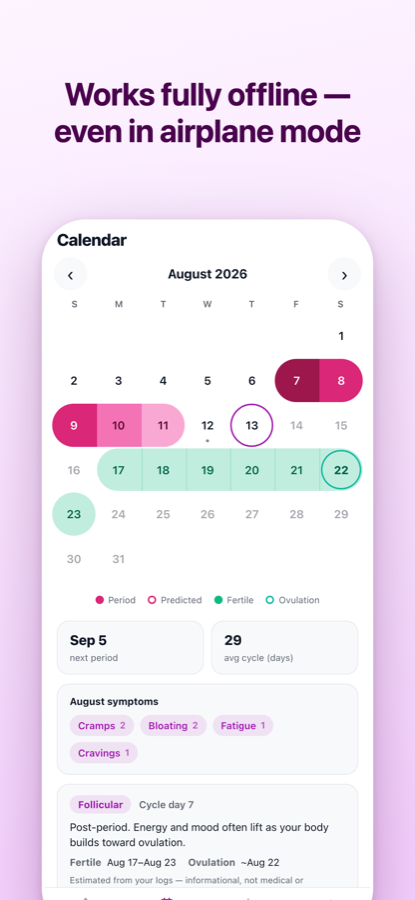
This is the most revealing test, and almost nobody runs it. If predictions, insights or your own history stop working with the radios off, those calculations are happening on a server — which means your data went there. If everything still works offline, the maths is running on your phone.
3 The export test
Do this: look for an export in settings, and check whether you can open the file it produces.
Portability is the practical test of ownership. If you cannot get your own years of cycle history out in a file you control, you don't really hold it — you're renting access to it. Bonus points if the export is encrypted with a passphrase only you know.
4 The delete test
Do this: find out what "delete my data" actually deletes. Read the privacy policy's retention section, or email support and ask.
Deleting an app removes what's on your phone. It does not, by itself, remove anything a company already copied to its servers or shared with partners. If a policy talks about "retention periods", "aggregated analytics", "advertising partners" or "affiliates", then something left your device, and deletion is a request rather than a fact.
Why this matters more for cycle data
Cycle data is not ordinary app data. It reveals whether you are sexually active, whether you are trying to conceive, whether you are pregnant, whether you miscarried, and when you are perimenopausal. It is some of the most sensitive information a phone holds — and unlike a password, you cannot rotate it after a breach.
The strongest protection is not a promise about how data is handled after it's collected. It's data that was never collected in the first place. An app that has no server and no account has nothing to leak, nothing to sell, nothing to subpoena and nothing to change its mind about later.
How Niah answers the four tests
Niah was built so that all four answers are the good ones, and so that you can verify them yourself rather than trust them.
| Test | Niah |
|---|---|
| Account required | No. There is no sign-up and no account to create — open it and log. |
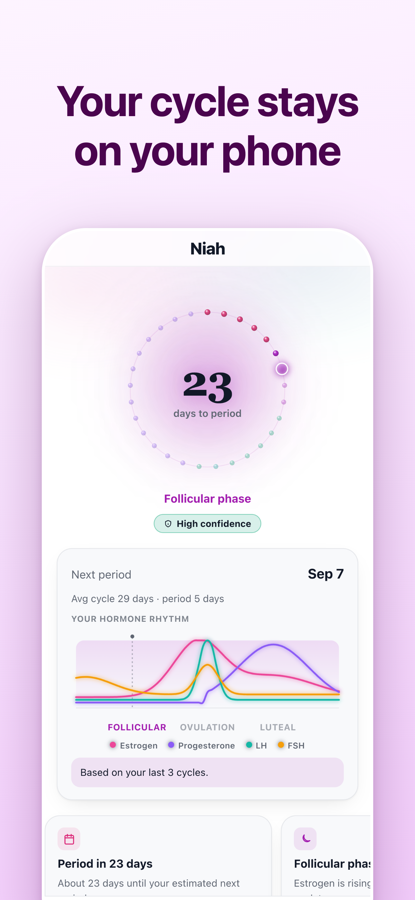
| Works in Airplane Mode | Yes. Logging, predictions, calendar, insights, reminders, widgets and the Watch app all run on-device. |
| Export your data | Yes. A backup you export and import yourself. When you choose a passphrase, the backup is encrypted and the passphrase never leaves your device. |
| Delete your data | Nothing to request from us. Use Delete all data in Niah settings to clear local entries and the widget snapshot. If you turned on Apple Health sync, delete that copy in the Health app too. |
Because Niah has no server that receives your cycle data, the developer cannot see your cycle: it never arrives anywhere they could look. Niah does not sell, share or use cycle data for marketing. Apple does provide every developer with aggregate, non-identifying App Store reporting — downloads, and opt-in aggregate usage — and the privacy policy says so plainly in section 3 rather than hiding behind "we collect nothing". It's short, and specific.
What Niah does beyond privacy
Privacy alone isn't a reason to use a tracker; it has to actually work.
- Log your period in a single tap — flow, symptoms and mood from a tap-to-log library.
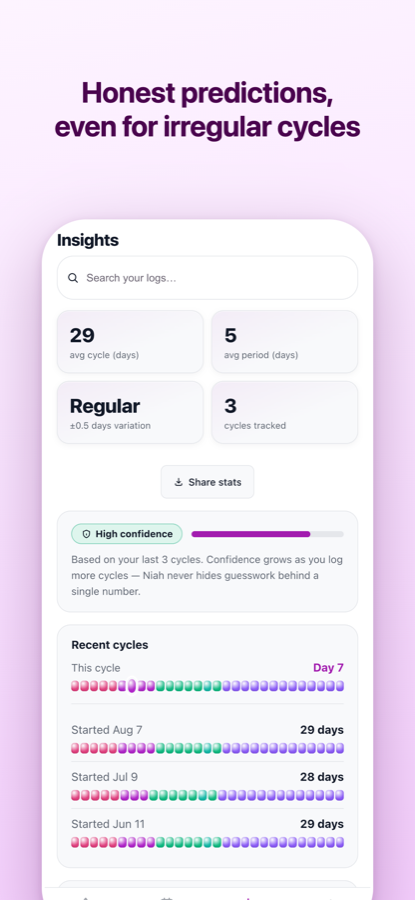
- Predictions for your next period and fertile window that show a range when your cycles are irregular, instead of pretending every cycle is the same length.
- Cycle length, period length and regularity trends.
- Trying to conceive: basal body temperature, ovulation tests and cervical mucus logging.
- Perimenopause and pregnancy tracking.
- Optional two-way Apple Health sync, home-screen widgets and an Apple Watch app.
- Fertility predictions and advanced insights are included — there is no subscription and nothing to unlock.
Questions people ask about period-tracker privacy
How can I tell if a period tracker sends my data to a server?
Turn on Airplane Mode and use the app. If predictions, insights or your own history stop working with the radios off, those calculations run on a server, which means your data is sent there. If everything still works offline, the processing happens on your phone.
Does a period tracker need an account?
No. An account exists to tie your entries to an identity on a server. An app that never asks who you are has nothing to link your cycle history to. Niah has no sign-up at all.
Does deleting a period tracking app delete my data?
Deleting an app removes its sandboxed local data. Niah clears its small widget snapshot on the first launch after reinstall, or immediately through Delete all data in Settings. Apple Health copies and files you exported or shared are separate and must be deleted where they live.
Is Niah free, and is there a subscription?
Niah is free and there is no subscription. Fertility and ovulation predictions, advanced insights, widgets, the Apple Watch app and encrypted backups are all included, with nothing to unlock.
Private · iPhone & Apple Watch · iOS 15 or later · no account · encrypted backups
Health note. Niah is an informational tracking tool, not a medical device. It does not diagnose or treat any condition, and it must not be used as a method of contraception. Fertile-window estimates are statistical predictions and can be wrong. For advice about your health, your cycle, contraception, conception or pregnancy, talk to a qualified healthcare professional.